
Key takeaways
Teen brand loyalty now works like a lease: the share of U.S. teens naming Nike their favorite footwear brand fell from 61% to 46% between fall 2023 and fall 2025, while Adidas, New Balance and On gained.
Kids pick the brand, often by age seven, and parents keep the veto on safety, price and durability. Brands that sell “cool” and “safe” together win both.
The audience has splintered across niche sports and social feeds, and follower count now matters alongside the scoreboard. Brands need to pick a specific kid, move faster, and set clear rules for what they pay young athletes to post.
Mere minutes after the New York Knicks beat the San Antonio Spurs in Game 5 of the NBA Finals to win their first title in over 50 years, Nike released a 40-second video shot by diehard Knicks fan Josh Safdie (yes, that Josh Safdie).
It follows a single kid in a Jalen Brunson jersey running through Manhattan as “New York State of Mind” plays. The Nike Swoosh only appears at the very end, after a simple line: “Never slept. Always dreamed.”
We could write an entire blog about this 40-second spot because, when it comes to big-splash monoculture moments, Nike remains unrivaled for having the right ad in the right place at the right time.
But there’s something more interesting afoot. Think about it: How many millennials waited their whole life for a Knicks title? How many boomers suffered through the entire 53-year drought? And how many of them were featured in this commercial? The answer to that last question is none, and that’s no accident.
As both current participants in youth sports and potential future lifelong customers, young people are aggressively courted by Sporting Goods & Apparel brands long before they have purchasing power. But the youth, just like you and me, are fickle.
Brands thus advertise to kids in the language of the sport they are playing, driving loyalty within that particular segment, making a play for a lifelong consumer who, after they hang up their cleats, puts on a pair of branded lifestyle sneakers for the rest of their life.
The long game is getting harder to win. Kids pick their brands earlier, the audience has splintered across niche sports and feeds, and challengers have been pulling teens away from the biggest legacy names in the business.
Below, we follow the money in youth sports, considering how kids and parents split buying decisions, how the upstarts win teens over, and how priorities have shifted from scoreboard to follower count. We close with five questions every brand in the category should be able to answer about their youth strategy.
Parents Lose the Wheel but Keep the Brakes
When it comes to equipment, kids quickly take the steering wheel, and three seemingly universal truths shape how far parents let them drive:
No parent wants their kid bullied
No parent wants their kid injured
No parent wants their kid left behind
Parents know the nag factor all too well: brands market to kids so kids push their parents to buy. You know your kid needs cleats, and by the time they’re about seven, they already know which ones they want, because it’s what their friends wear and their heroes endorse. No parent wants to tell their kid to be different when all they want is to fit in.
But while parents have surrendered the steering wheel, they still pump the brakes if a product doesn’t keep their kid safe. A helmet can be the coolest thing on the planet, but a parent won’t buy it if it doesn’t protect their kid’s head.
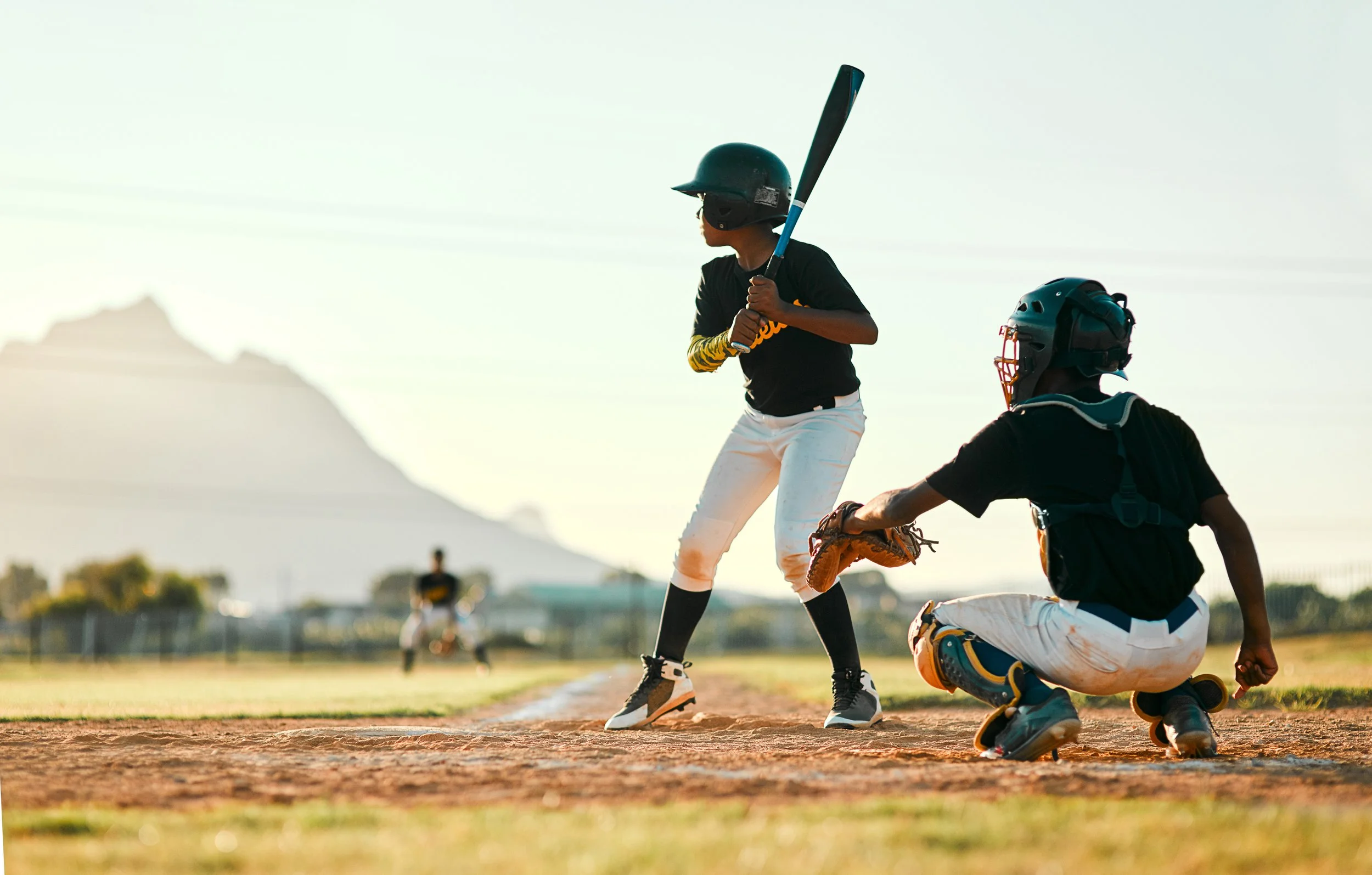
EvoShield sells cool and safe at the same time. The Wilson-owned brand makes protective gear that molds to the athlete, in a wide range of colors, and any kids’ ballfield shows why it works: each little batter straps on wrist, shin, and elbow guards just like the big leaguers on TV and the varsity players on IG. It’s probably overkill, but kids want the look and parents want the protection.
Parents also want the best for their kid, which is why celebrity sponsorships work on them even when the star means little to the child. If a product is good enough for Tiger or Serena, and it helped make them the best, then surely it’s good enough for their kid too.

From Watercoolers to Micro Communities
If the game were this simple, the legacy brands, especially Nike, would dominate the landscape. For Nike, the Knicks video was a big watercooler win in one of the nation’s big four sports.
The trouble is, the watercooler ain’t what it used to be, is it? Kids aren’t playing the same sports as their parents, and they aren’t consuming the same media either.
Consider girls flag football. In the 2025-26 season, more than 100,000 girls played high school flag football, a 551% increase in four years. The number of states that sanction it has nearly doubled since 2024, and it makes its Olympic debut at the 2028 Los Angeles Games. That’s niche to national spotlight in under a decade, and brands have noticed: Under Armour released The Future Is Flag on Prime Video in February 2026, a documentary following two of its athletes, Mexico quarterback Diana Flores and U.S. center Ashlea Klam, toward that debut.
Then there’s running, which, if you hadn’t heard, young people are into again. Even running splits into casual, performance, and lifestyle buyers. A performance runner would wear a gravy boat if it made them faster, while a lifestyle buyer cares about street appeal and will bite at a tasty rapper collab the performance crowd couldn’t care less about. Each segment needs its own product story, endorsements, and sales channels, and that’s before you throw in the fluidity and variabilities of youth taste.
Social media became the watercooler and then it killed it, fracturing monoculture into a million niche pieces. When youth trends start with TikTok creators, big incumbents often show up late to the party or don’t get invited at all, leaving challengers the space to engage these consumers on their own terms.
Upstarts, Legacies, and the Shoes Your Parents Wore
Nike is still the most popular footwear brand among American teens, and it isn’t particularly close. The lead is shrinking, though. In Piper Sandler’s fall 2023 Taking Stock With Teens survey, 61% of teens named Nike their favorite footwear brand. By fall 2025, that number was 46%, and Piper’s 2026 survey says the slide hasn’t stopped.
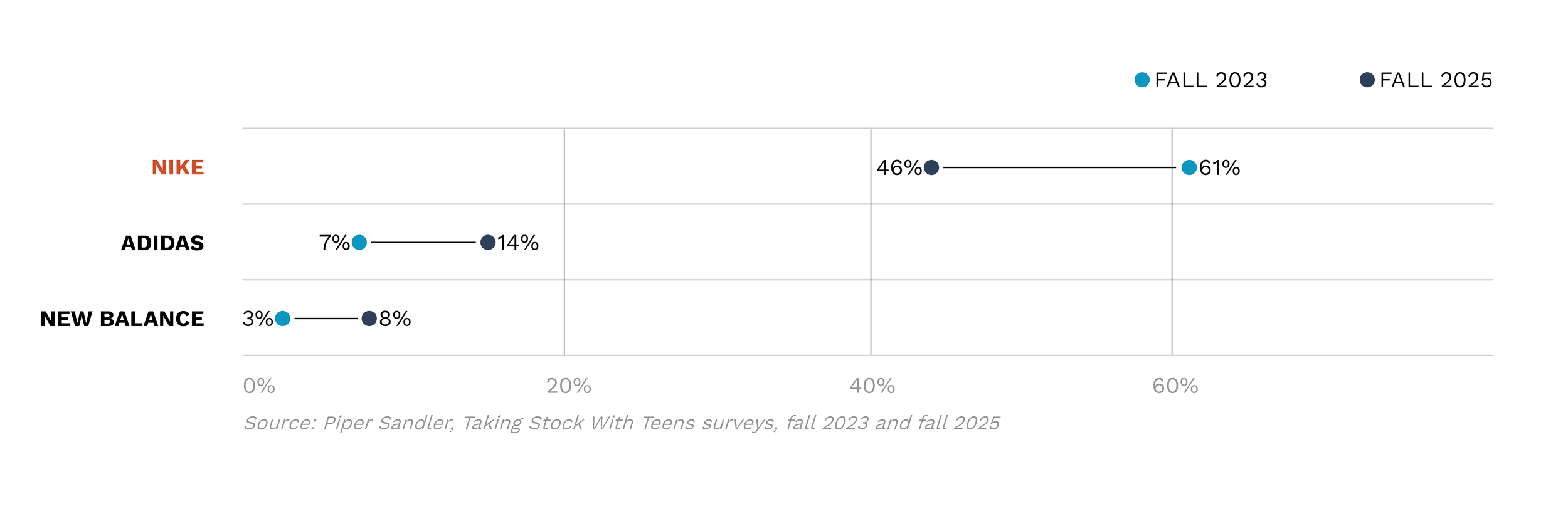
Adidas and New Balance picked up most of those points, and On climbed from eighth to fourth, passing Hoka. Each took a different route.
On won on freshness: shoes that perform, a look that feels new, and none of the baggage of a brand your parents wore. It also picked its people early. On signed Ben Shelton in March 2023, when he was 20 and ranked 41st in the world, and by this spring he was ranked sixth. Zendaya, a multi-year On partner, carries the brand well beyond the court. (Federer, an On investor, is for the parents. Shelton and Zendaya are for the kids.)
New Balance, on the other hand, found a way to appeal to youth by appearing old. It was quite literally your dad’s shoe until younger consumers decided the dad shoe was cool, and sales nearly tripled between 2020 and 2025. It signs talent early, too: Coco Gauff joined at 14, and Cooper Flagg signed at 17, before his freshman year at Nike-sponsored Duke, then went first overall in the NBA Draft a year later. Adidas, meanwhile, rode a decades-old soccer shoe back into favor as teens traded Nike Dunks for Sambas.
None of this makes a challenger safe, something Under Armour has learned the hard way. It was the scrappy upstart once, started in 1996 by a former Maryland football player who sent shirts to old teammates in the NFL. By 2017, it was the No. 1 brand upper-income teen boys said they’d stopped wearing, and in fiscal 2026 it lost $496 million. Its flag football documentary reads as a bid to win back a generation.
Nike, for its part, isn’t standing still: its sales at specialty running stores rose 35% in the year through September 2025, faster than any other top-10 brand in that channel, according to Karnan Associates. So teen loyalty works more like a lease, and that brings us to the question every brand, upstart or incumbent, has to answer: what actually keeps a kid coming back?
Watching your teen share move? We help sporting goods and apparel brands decide which kid to build for, then build the go-to-market to reach them. Let's compare notes.
From Scoreboard to Follower Count
For most of the last 40 years, the endorsement playbook fit on an index card: find the best athlete in the sport, put your logo on them, and wait for the highlights. Nike went all in on a rookie named Michael Jordan in 1984, and every time he put one through the hoop, a Nike cash register rang. They’re still ringing. Even after a 16% slide, Jordan Brand brought in $7.3 billion in Nike’s 2025 fiscal year.
Then the scoreboard got some competition. In July 2021, the NCAA began allowing college athletes to profit from their name, image, and likeness, and brands learned to read a second stat line.
That September, LSU gymnast Livvy Dunne signed her first NIL deal, with Vuori. She was a good gymnast (she’d help LSU win its first national title in 2024), and she was also the most-followed college athlete on social media, with 5.7 million followers. Vuori’s announcement credited both her gymnastics and “the positivity she spreads on social media.” It should go without saying that the old playbook never had a section for positivity spread through social media.
The money has followed the followers: Opendorse estimates college athletes will be paid $4.5 billion in the 2026-27 school year, counting schools’ revenue-sharing payments. And the athletes keep getting younger. Nike signed three high schoolers to NIL deals in 2022, including Bronny James and JuJu Watkins, and more than 40 states now let high school athletes sign deals of their own.
Those deals, notably, come attached to several strings: many states bar the use of school logos and uniforms, and some rule out vice categories entirely, so a brand can sponsor the kid but not the jersey.
Aspiring athletes (and their parents!) understand the new game, and plenty of them build an audience before anyone offers a deal through unboxing videos, training footage, game montages. It works because kids follow kids. A middle schooler can get starstruck by a peer with 40,000 followers, whatever that peer averages per game, and scouts now weigh a prospect’s following alongside what happens on the field.
The stage is enormous: Pew Research Center found in late 2025 that 61% of U.S. teens use TikTok every day, a few points more than the share of high schoolers who play on even one sports team (57.6%). Finding the right kids on TikTok takes social listening, the modern version of the “cool hunters” PBS Frontline profiled in 2001’s The Merchants of Cool, now on an accelerated clock that moves faster than most product calendars.
Paying kids to post also forces brands to take on a new responsibility. When crowds of mostly young men disrupted an LSU meet in Utah in 2023 to see Dunne, the school added security for road trips, and she was a 20-year-old college athlete. When the athlete is 14, every brand in the space should be able to say plainly whether anything it funds sexualizes or endangers the kids in it, both because it is a moral imperative and because the parents who kept the brakes are on Instagram too, and they’re watching.
Playing for Keeps
So what keeps a kid coming back? Go back to that 40-second Knicks spot. It had a scoreboard hero in Finals MVP Jalen Brunson, and it cast a kid as the lead. It ran on the platforms that kid lives on, minutes after the moment he’d waited his whole life for (however long that life has been thus far). And there wasn’t a frame in it a parent would object to. Identity before product, the right athlete, speed, and the parent’s sign-off: it’s all in those 40 seconds.
Nike could pull that off because it had the hero, the budget, and months of lead time. Challengers rarely have all three, so they pick their spots, the way On did with Shelton and New Balance did with Flagg. Upstart or incumbent, the prize is the kid who hangs up the cleats and keeps buying the brand for the next 50 years. Nike earned its shot at those kids in 40 seconds. The rest of the category is still working out how to earn theirs.
Where Most Brands Get Stuck
Most brands we talk to already know which kids they want. Where they stall is behind the scenes: a product hierarchy built for "all kids," an approval process that turns a two-day trend into a two-month campaign, and data that can't tell them which sport, region or age group is moving. Those are operating problems, not marketing ones, and they're the ones we spend our days on.
Five Questions Before Next Season
Working it out starts with a question we ask our clients all the time: who, specifically, are you building for? In youth sports, that question breaks into a few more.
Which kid? “All kids” stopped being an answer a while ago. Pick a near-term trend, a niche you can own, or a sport where you’re willing to build a long-term position, and then go after it hard.
Where does that kid first see your brand, and who’s holding the camera? Odds are it’s a phone, whether it’s a teammate’s TikTok or a parent livestreaming the game on GameChanger.
What do parents see when they check you out? Price, safety, and durability decide whether whatever the kid threw in the cart makes it to checkout.
Would you be comfortable showing a parent everything you’ve paid a kid to post? If you don’t answer “yes” within a split second, that’s a big problem, and your current starting point.
Is your content built for today or for tomorrow? If a post takes a quarter to get approved, the moment it was made for is long gone.
If your team is working through these questions, let’s compare notes. Not ready to talk yet? See how we work with sporting goods and apparel brands.