
From Journey Mapping to Journey Management: Excelerate’s Practical CX Path to ROI
Forrester kicked off 2026 with a bold prediction: “Two-thirds of CX teams will abandon journey mapping due to a self-inflicted stigma.”
Wow, two-thirds, that’s quite a bit.
It seems that journey mapping—the practice of visualizing an end-to-end experience from a customer’s perspective—took a wrong turn somewhere, with only 30% of CX decision-makers believing their teams have the skills to create high-quality maps. And even if the maps were high quality, journey owners, according to Forrester, have been isolated—walled off from other business units, unable to drive tangible business value.
At Excelerate, we see this trend not as an indictment of journey mapping but as evidence that it’s been treated as an endpoint instead of a management tool.
In the wrong hands, journey maps often become a destination unto themselves, the beginning and end of a visualization exercise. But journey maps were never meant to be the destination.
In Excelerate’s hands, however, they are merely one step on a broader customer-centric journey to Return on Investment (ROI). Journey mapping is an invaluable tool in our CX toolkit, one that we deploy intentionally to drive specific, realizable value for our clients.
Journey Managing, Not Journey Mapping
At Excelerate, journey maps are an integral step on the road to ROI, which incorporates original research and segmentations, immerses organizations in customer-centric thinking, and, most importantly, results in clearly actionable and executable opportunity prioritization.
Our journey maps are not fanciful, hypothesized versions of an ideal state, nor are they motivational office decorations. Instead, we provide intentionally honest current state illustrations of the customer journey that inform our clients’ investment prioritization and decision-making.
If our journey maps do not lead to tangible business value, they do not live up to the Excelerate way.
“If our journey maps do not lead to tangible business value, they do not live up to the Excelerate way.”
What Makes Excelerate’s Process Different – 4 Keys to Success
To yield any kind of useful business output, journey mapping must have the right inputs, framework, and support. We integrate this truth into our journey mapping process, with four key approaches:
1. Inputs from Research, not Feelings: We come into journey mapping armed with qualitative or quantitative data and insights based on original research across business units and grounded in interviews or surveys. This provides a solid foundation without any guesswork or magical thinking, laying clear the quality and quantity of existing touchpoints.
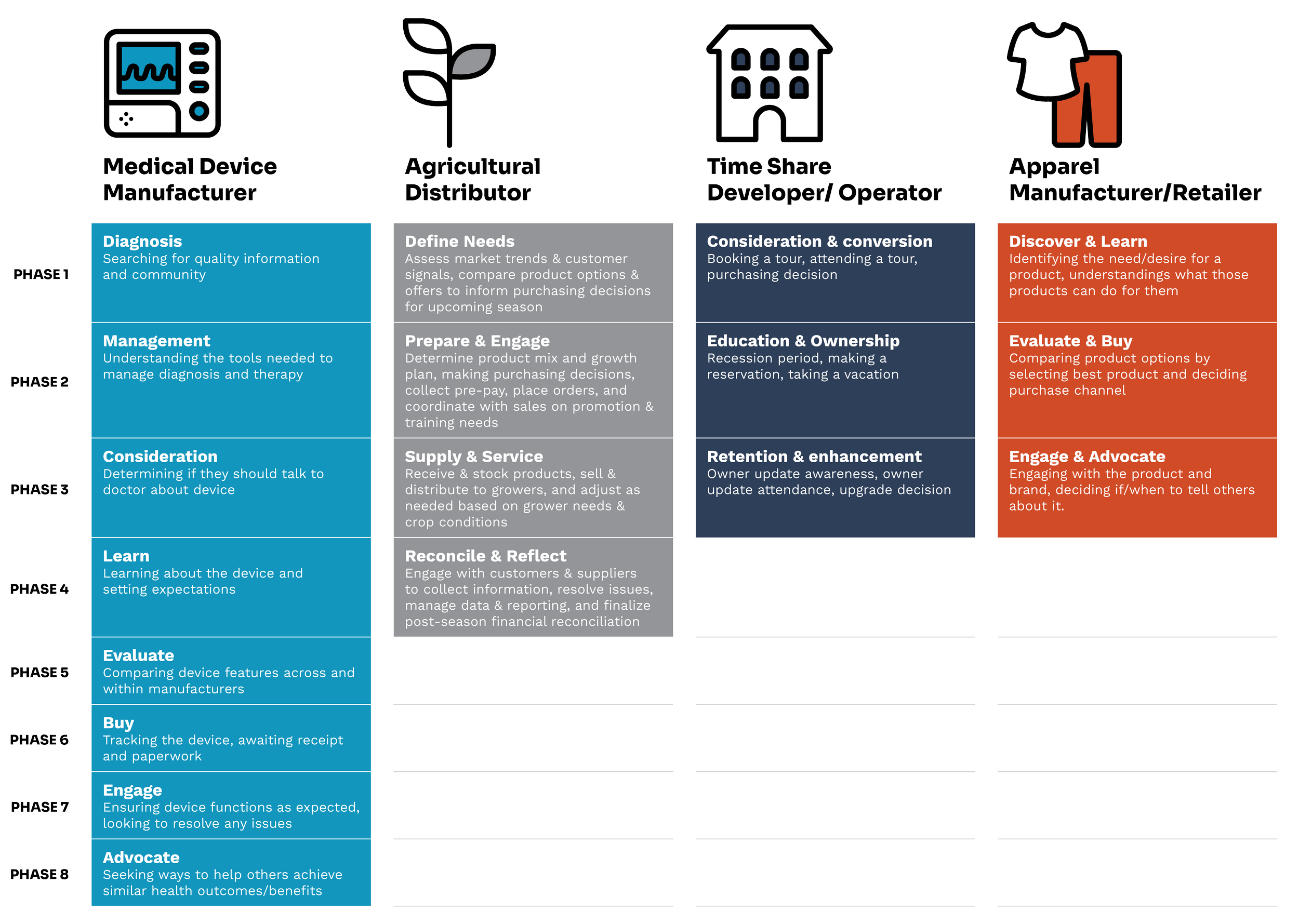
2. Custom, Adaptable Frameworks: There is no precise Excelerate formula for journey mapping, no repeatable and scalable plug-and-play process. We treat every brand’s customer journeys uniquely because, well, they are unique. This means, the phase names are specific to them and what is highlighted in the maps is right sized to what needs to be accomplished from this effort for their unique circumstance.
3. Support through Execution via Change Management & Training: We support our customers’ journey through journey mapping with change and execution management, ensuring the labor put in is reinforced not wasted, discarded, or otherwise ignored. This includes immersive training with scenarios (e.g., you are considering a choice between two initiatives – use the journey map to decide which one will deliver the greater customer impact).
4. A Path to Implementation and Value: Journey maps are glorified wall art if they do not map pathways to ROI. We cannot overstate the simplicity or importance of this fact. Note that implementation and value only emerge with the necessary inputs, framework, and support. Journey maps were never meant to stand on their own.
Individually, each of these keys strengthens journey mapping; together, they are what allow it to drive real ROI. When properly oriented and equipped to drive value, journey mapping provides an irreplaceable window into buyers’ path-to-purchase. Seeing the buyers’ journey as a customer helps teams identify opportunities to prioritize based on estimated benefit and effort in order to focus resources on activities that effectively drive growth.
Journey Maps Must Chart a Valuable Course
When journey mapping is grounded in real research, built for a specific business context, and supported through execution, it stops being a workshop exercise and starts functioning as a management discipline. This is the inflection point where mapping gives way to managing—where insight turns into action, and action into measurable return.
This is also where many journey mapping efforts fall apart. Without a clear path from insight to prioritization to execution, even the most thoughtful maps struggle to justify their existence. They’re informative but not transformational.
Excelerate approaches journey mapping with a different end in mind. We design it not as a moment of alignment, but as a mechanism for ongoing decision-making—one that actively guides where teams invest, how they prioritize, and how they improve the experience in ways that matter to both customers and the business.
“When journey mapping is grounded in real research, built for a specific business context, and supported through execution, it stops being a workshop exercise and starts functioning as a management discipline.”
Viewed through this lens, journey mapping should reliably produce three distinct, connected value streams that move it from a visualization tool to a driver of ROI:
Immersion in customer-centric thinking
Opportunity identification and prioritization
Operationalizing and embedding journey-led decisions across the organization
The remainder of this blog explores how each of these value streams shows up for Excelerate’s clients in practice.
Value #1: Immersion in Customer-Centric Thinking, Where Advocacies are Built and Buy-In Secured
As a facilitated exercise, journey mapping brings customer-centric thinking across an organization. Immersing teams in research findings and a customer mindset develops new ways of identifying opportunities through a customer-centric lens, giving an organization a shared understanding. This in turn builds internal advocacies for customer-centric initiatives and secures buy-in across collaborative business units.
On its own, this is already a big win for organizations and the teams within them. Embarking on a shared journey from different starting points brings novel solutions. Design thinkers, for example, are likely to find empathy and immersion in a journey mapping exercise whereas people coming for business value will approach the exercise analytically.
Yet regardless of approach and origin point, the organization emerges with a common set of terms and understandings that breeds familiarity and secures buy-in for the very initiatives that seek to manage, not merely map, customer journeys.
Value #2: Opportunity Identification and Prioritization, Where the Rubber Meets the ROI Road
Journey maps are entry points to actions that will attract, convert, and retain customers.
Once an organization collectively understands customer pain points and the obstacles on their path to purchase, it is positioned to take collective action to address them. Opportunity prioritization informs and directs this collective action—this is where journey mapping goes from workshop activity to a hard practice that drives business results.
Easier said than done, right? How do we go about prioritizing opportunities?
We do this by breaking customers into segmentations based on their priorities and pain points, and weighing their collective influence (i.e. buying power) paired with the effort to reach and serve them. Businesses can then launch initiatives that balance buying power with cost to serve in order to remove friction for the most profitable customer segments along their path to purchase.
Said differently, journey mapping is a key step in the effort to identify high impact improvement opportunities and allocate investments where they deliver the greatest value. It’s how leadership teams move from “everything matters” to a defensible, customer‑led investment roadmap.
And there are overlaps in this investment roadmap—different customer groups often share pain points and, consequently, the path to address these pain points can be similarly shared across segmentations. This means that, through the journey mapping exercise, businesses can not only identify the means to better address customer groups, but also commonalities among them. It is these shared efforts that drive the greatest return on investment.
Value #3: Operationalizing & Embedding Journey Map Usage Cross-Functionally
When we facilitate journey mapping exercises for our clients, we work with them to not just prioritize opportunities but also to operationalize this prioritization across the organization.
We never complete a journey map, throw in a free frame, nail it to the wall, and call it a day. Instead, we work across business units to train teams to make decisions for their respective departments, which cascade through the organization.
For example, Go-to-Market (GTM) launch planning must be viewed through a customer-centric lens, focused on deeply understanding your customer target(s), identifying the top opportunities to attract and convert them, and then prioritizing the GTM initiatives based on a thorough benefit/effort analysis.
Excelerate develops detailed implementation plans, and often ROI analysis, for top initiatives to ensure teams can easily apply journey mapping outputs to manage real world product launches. In this context journey maps are neither fanciful nor fruitless but rather a fundamental ingredient in the go-to-market formula.
“Journey maps are entry points to actions that will attract, convert, and retain customers.”
Conclusion: The Journey Was Never the Destination
None of this is theoretical, projected, or imagined—we are not talking about best-case scenarios. Our journey mapping methodology emerged from real work with both B2B and B2C clients who we empowered to better understand their customer journey, and to better prioritize the initiatives to improve it.
In fact, here is a quick testimonial page from clients we’ve guided through journey mapping—note how many of them talk about the tangible business value this process drives.
This is why, though journey mapping has been misapplied and under supported, leaders do their organization a disservice when they abandon it entirely.
At Excelerate, we’ve built a methodology and toolkit around the journey mapping process that reduces uncertainty for our clients, enabling them to make considered, data-driven decisions that mitigate friction for their business and their customers.
That’s the destination journey mapping can take you to.