

Culture is easy to talk about but hard to operationalize.
Every organization has values, sure, but few have a shared understanding of how those values should guide day-to-day decisions. Fewer still have taken the time to write those expectations down in a way their people can actually use.
This is especially true for fast-paced, complex work and, at Excelerate, we learned this firsthand.
That’s why we internally developed and published our Culture Playbook, not to define an aspirational future state but rather to make explicit how we already work—and how we expect to work—as a firm that helps clients implement change, not merely design it.
This blog explains how we built that Culture Playbook, why we think it matters enough to share with you, and how it signals our approach to organizational enablement.
The Problem We Were Trying to Solve
Excelerate’s work exists between strategy and execution: You bring us in when initiatives matter, timelines are tight, and ambiguity is unavoidable.
Over time in the trenches with our clients, we noticed a pattern. The organizations that struggled to maintain momentum didn’t lack intelligence or effort—these are smart people working at smart companies. No, instead they lacked clarity surrounding priorities, decision-making, expectations, and ways of working. That dynamic slowed progress and drained energy, starving and stalling transformations.
As we reflected on this, we asked ourselves an uncomfortable question: Were we always as explicit internally as we encouraged our clients to be?
Our value proposition—helping organizations move faster and smarter—was clear. But the internal behaviors required to consistently deliver on that promise in ways that align to our values (integrity, flexibility, energy, and humility) were not fully articulated or shared across the firm.
The Culture Playbook was our way of closing that gap.
What the Culture Playbook Actually Is
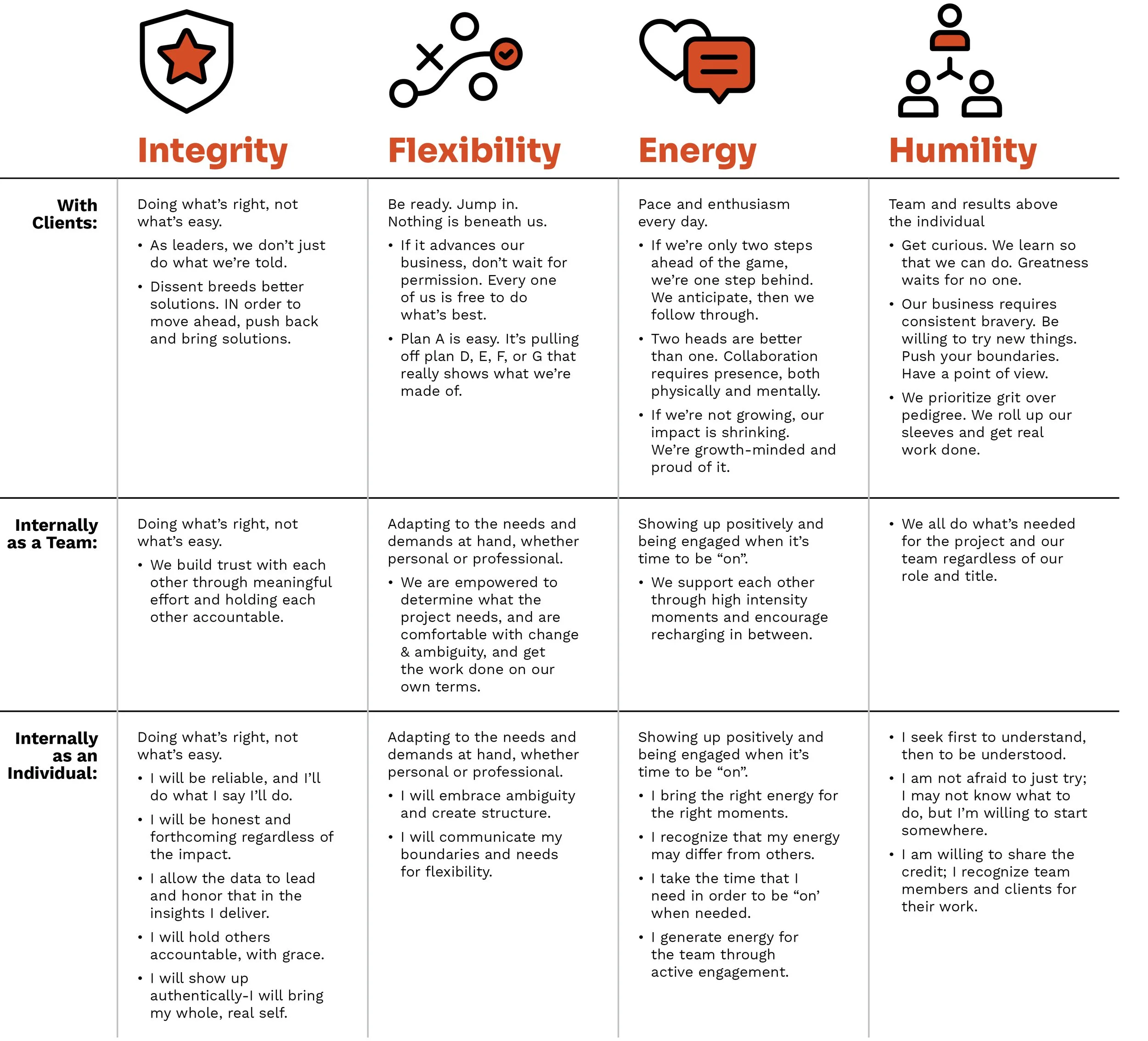
The Culture Playbook is a living document that captures how we expect Excelerators to show up for one another in order to serve our clients. It is neither a branding artifact nor an HR handbook but instead a tangible guide that addresses practical questions, including:
What kinds of behaviors do we value when things are going well…and when they aren’t?
What are our expectations for turnaround time across different communication channels?
How do we balance autonomy with accountability? Work with life?
How do we handle disagreements and encourage productive feedback?
Rather than treating behaviors and values as abstract and unchanging ideals, the Playbook treats them dynamically, and connects them to real situations such as delivery pressure, client dynamics, internal collaboration, and growth.
“Rather than treating behaviors and values as abstract and unchanging ideals, the Playbook treats them dynamically, and connects them to real situations such as delivery pressure, client dynamics, internal collaboration, and growth.”
How It Was Built
One of the reasons we’re so proud of our Culture Playbook is that it was truly a collective effort. This wasn’t written in a vacuum or from the top-down.
In fact, most of the language had already been created by our teams over time in the context of real work. Norms around collaboration, feedback, learning, and decision-making had been articulated in different places, for different reasons.
Eventually, it became clear that we didn’t need more or new ideas, we needed coherence around what we already had, and the Playbook offered the perfect medium to bring those ideas together into a single narrative. It’s not there to impose a new culture, but to make the existing one visible and easier to navigate, especially as Excelerate continues to grow.
When we shared it internally, Excelerators saw their lived experiences reflected back to them, which was exactly the point: The Playbook exists to both guide them and follow their lead.
“Eventually, it became clear that we didn’t need more or new ideas, we needed coherence around what we already had.”
How It Translates Values into Behaviors
There’s often a gap between stated values and actual behavior, a chasm between theory and practice, that we sought to avoid.
In the Playbook, we define our values (integrity, flexibility, energy, and humility) through action, not slogans. We describe each of our four values in terms of how it shows up internally and externally, and where tensions can arise.
These distinctions matter. They reduce ambiguity and give teams a shared language for navigating real situations, not hypothetical or idealized ones.
“The Culture Playbook reflects our belief that organizational effectiveness is built on clear expectations, not good intentions. The same principles we help clients establish—clarity, empowerment, accountability, and adaptability—are the ones we rely on internally to deliver our work.”
Why This Matters Beyond Excelerate
From a client perspective, culture often feels intangible…until it becomes a far-too-real roadblock on the way to transformation.
Execution slows when teams don’t know who decides.
Change stalls when feedback is avoided.
Initiatives lose momentum when ways of working are misaligned with goals.
The Culture Playbook reflects our belief that organizational effectiveness is built on clear expectations, not good intentions. The same principles we help clients establish—clarity, empowerment, accountability, and adaptability—are the ones we rely on internally to deliver our work.
We’ve heard this reflected back to us by clients, often without prompting.
They notice how our teams collaborate, how decisions get made, how we navigate ambiguity, and how all of that enables our consultants’ enterprise thinking. This feedback suggests alignment between how we operate internally and how we show up externally, and we are very proud of it.
Why We’re Sharing It
We’re not sharing the Culture Playbook to take a victory lap or because we think we’ve “solved” culture. We haven’t. No organization ever will. Culture is not static; it is constantly in motion.
Instead, we’re sharing it because too many organizations underestimate how much friction comes from unspoken expectations. Writing things down doesn’t eliminate complexity, but it does make it easier to address.
If this prompts leaders to take a more deliberate look at how their organizations actually work, not just how they’re designed, we think that’s worthwhile. Because culture happens whether leaders influence it or not, so best to be intentional, collaborative, and clear as you shape it.
And if you’re facing challenges around execution, alignment, or scale, those issues are often less about strategy and more about enablement. That’s the work we care about, and it’s the work the Culture Playbook helps us do better.
“Too many organizations underestimate how much friction comes from unspoken expectations. Writing things down doesn’t eliminate complexity, but it does make it easier to address.”